


SCAR REVISION · GREGORY HILLS
Scar Reconstruction & Revision
Explore assessment and treatment of scars after surgery, injury, burns or acne with the Pure Visage specialist plastic surgery team.
UNDERSTANDING SCARS
Revision aims to improve a scar, not erase it.
Surgery, burns, cuts and other skin injuries can leave scars. Many become less noticeable with time, while some remain raised, wide, depressed or tight. Scar revision may improve appearance, comfort or movement using surgical or non-surgical methods. Dr Michael Kernohan and Dr Varun Harish are specialist plastic surgeons whose scar-care options can be discussed at Pure Visage.
Why do scars form?
After an injury, the skin repairs itself. Fibroblasts produce collagen to close a deeper wound; the new tissue forms a scar. During maturation the collagen can remodel and contract, changing texture and tightness. Depth, wound tension, location and individual healing all affect the result.
Small scars may settle over months. A scar that grows beyond the wound, becomes thick within it, pulls on a joint or remains troublesome deserves individual assessment.
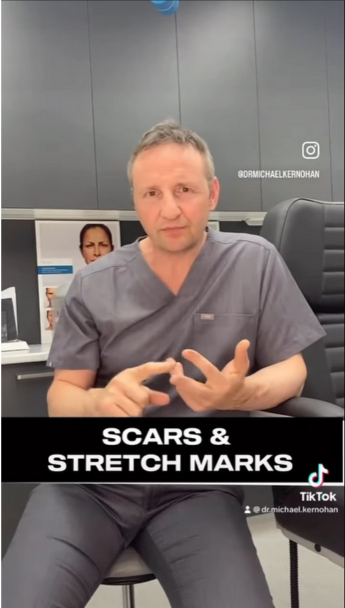
Watch Dr Kernohan explain scar revision ↗ · Watch his explanation of keloid scars ↗
RECOGNISING THE SCAR
Different scars need different plans.
01 · RAISED BEYOND THE WOUND
Keloid scars
A keloid grows beyond the original wound edges. Options may include silicone, steroid injections or excision, often with measures to reduce recurrence. Cryotherapy is discussed in the source article but is not offered at this clinic.
02 · RAISED WITHIN THE WOUND
Hypertrophic scars
These remain within the wound boundary. Silicone sheeting, injections, surgery or selected surface treatments may be considered according to location and thickness.
03 · TIGHT OR RESTRICTIVE
Contracture and burn scars
A contracted scar can pull on surrounding skin or restrict movement around a joint. Reconstructive methods such as local tissue rearrangement or grafting may be considered.
04 · DEPRESSED OR TEXTURED
Acne and atrophic scars
Acne and other depressed scars vary by skin type and depth. Options can include surface treatments, fat grafting or volumising treatments where appropriate.
05 · OTHER OR COMPLEX
Graft and self-harm scars
Skin-graft, surgical and self-harm scars can be assessed sensitively. Improvement varies between people and complete removal is not realistic.
Treatment availability, including laser, light therapy and other surface treatments mentioned in the source article, should be confirmed with the clinic before making plans.
WHEN TO SEEK ADVICE
Begin with the concern that matters to you.
Not every scar needs treatment. Consider an assessment if it is painful or itchy, growing or raised, affecting a visible or intimate area, or limiting movement. The age of the scar matters because scars continue to mature. Your surgeon can explain whether observation, non-surgical care or revision is appropriate now.
At consultation, discuss how the scar arose, how it changed, previous treatments, symptoms, medical history and what improvement you hope for. Bring relevant photographs, reports, medicines and questions. Ask about likely benefits, limitations, recurrence and who will provide follow-up.

PREPARE FOR YOUR VISIT
Questions worth bringing
- How did the scar form and when did it first change?
- Does it hurt, itch, feel tight or limit movement?
- Have you formed keloids or hypertrophic scars before?
- What treatments have you tried and what happened?
- What result would be meaningful, and what trade-offs are acceptable?
SURGICAL TECHNIQUES
Ways a scar may be reshaped.
Surgery creates a new wound and therefore a new scar. The aim is to improve placement, contour or tension where possible. Choice depends on scar size, direction, location, surrounding skin and risk of recurrence.
01 · SCAR EXCISION
Elliptical excision and closure
A small or straight scar may be removed in an ellipse, then closed with fine sutures. The replacement line may heal more evenly, but remains a scar.
02 · LOCAL FLAPS
Z-plasty and variations
Z-plasty repositions small skin flaps to change scar direction or release tightness. Multiple Z-plasties and variants may be used for longer or curved scars.
03 · BROKEN-LINE CLOSURE
W-plasty and GBLC
W-plasty and geometric broken-line closure interrupt a straight scar line. These techniques may help camouflage selected irregular scars.
04 · ADVANCEMENT
V-Y or Y-V reshaping
Local tissue advancement can release a contracted area or reshape a lax scar. Suitability depends on nearby tissue and the functional goal.
05 · LARGER DEFECTS
Skin grafting
After excision of a large or tight scar, a skin graft from elsewhere on the body may help cover the wound when direct closure is not appropriate.
NON-SURGICAL & COMBINED OPTIONS
Care beyond excision.
DEPRESSED SCARS
Fat grafting or volumising
Fat transfer uses your own tissue and involves harvesting it from another site; it is a procedure, not simply a cream or injection. Volumising treatments may raise selected depressed scars, sometimes needing repeat treatment.
RAISED SCARS
Injectable medicines and silicone
Corticosteroid injections and silicone gels or sheets may help selected thick or raised scars. Your clinician can explain the expected course and chance of recurrence.
SURFACE & COLOUR
Peels, dermabrasion and creams
Chemical peels, dermabrasion and prescribed topical care may suit some superficial scars. Laser and light treatments are mentioned in the source article; confirm current availability and suitability with the clinic.
No method guarantees that a scar disappears. A combined plan and follow-up may be more useful than a single procedure.
PROCEDURE & AFTERCARE
Know what healing may involve.
Many smaller revisions are outpatient procedures under local anaesthesia. Larger, complex or graft-based procedures may require sedation or general anaesthesia. The source article describes examples ranging from about 20 minutes to two hours or longer; your actual procedure and transport needs depend on the plan.
A small surgical wound may heal over roughly one to three weeks, while the scar remodels for many months. The source describes change over six to twelve months. Work, exercise and driving depend on the procedure, wound location and job demands; ask for your own timetable.
Follow wound-care advice, attend reviews, protect healing skin from sun and ask when silicone or other scar care can begin. Arrange transport if sedation is used.
RISKS & LIMITS
Discuss these before treatment
- Infection, bleeding or delayed healing
- A wider, raised or more noticeable new scar
- Altered sensation, discomfort or pigmentation change
- Recurrence, particularly with keloid scars
- Further treatment if the result does not meet the goal
COSTS & COVER
An individual quote follows assessment.
Fees depend on the scar, proposed technique, anaesthesia, treatment setting and follow-up. Ask for a written quote that explains surgeon, facility and anaesthetist costs where relevant. The source mentions payment plans; ask the clinic which current options, if any, are available.
Medicare or private insurance benefits are not automatic. Some medically necessary scar procedures may meet current item criteria, particularly when function is affected. The clinic can advise proposed item numbers, but you should verify eligibility and out-of-pocket costs with Medicare and your insurer.

COMMON QUESTIONS
Scar revision FAQs.
What do plastic surgeons recommend for scars?
It depends on scar type, age, symptoms and location. Options can include time and sun protection, silicone care, injections, surface treatments or surgery. An assessment determines what is suitable.
Can plastic surgery remove a scar?
Surgery can replace or reposition a scar, but it cannot make the skin completely unscarred. The goal is improvement in appearance, comfort or function.
Does scar revision surgery work?
Many scars can be improved, but the degree of change varies and some raised scars can recur. Your surgeon should explain the expected benefit and limitations for your scar.
When is the best time for scar revision?
Timing depends on how the scar is maturing, symptoms and whether movement is restricted. Some scars benefit from waiting; a painful or restrictive scar may need earlier review.
How can a raised scar be flattened?
Silicone care, corticosteroid injections and selected procedures may help, depending on whether the scar is hypertrophic or keloid. Keloids may recur after excision, so a combined plan may be discussed.
Can a scar be removed permanently?
A scar cannot be guaranteed to disappear permanently. Revision creates a new scar and its final appearance depends on healing, location and individual tendency to scar.
YOUR NEXT STEP
Start with a conversation.
Contact Pure Visage to discuss the appropriate scar assessment, current treatment availability and referral pathway. The right choice may be observation, non-surgical care or a procedure.
Explore related care
Explore our plastic surgeons · Patient Information · Referrer information